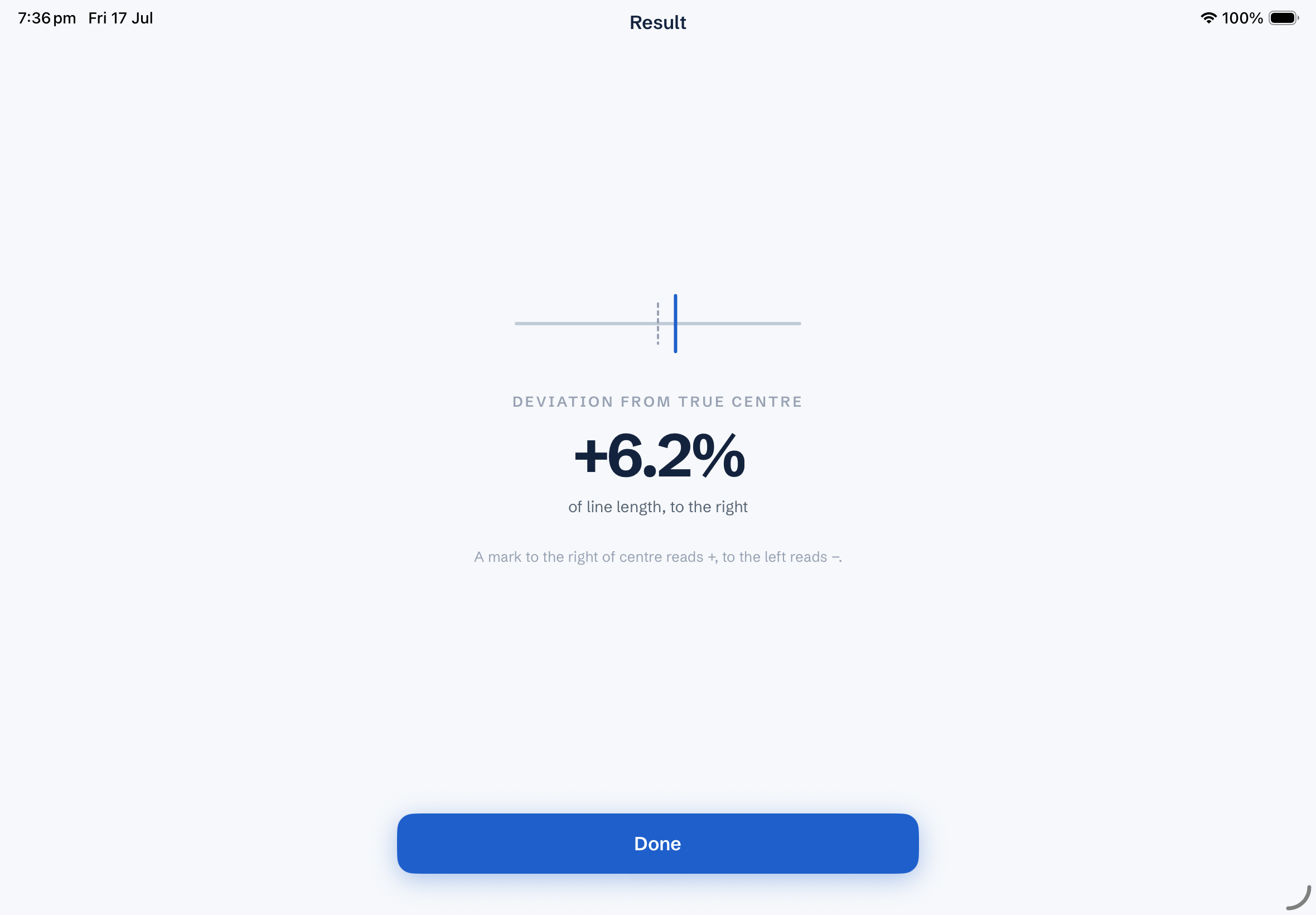
The line bisection test — show a patient a single horizontal line and ask them to mark its exact centre — is one of the oldest and most sensitive bedside screens for hemispatial neglect. It takes seconds to administer. Reading the deviation accurately, and recording it in a form you can compare at the next visit, is the harder part.
What the test actually measures
The task is simple: a line is drawn on a page (or, increasingly, a screen), and the patient marks the point they judge to be its exact centre. In a healthy visual-spatial system, that mark lands close to true midpoint. In a patient with hemispatial neglect — most often following a right-hemisphere stroke — attention is skewed toward one side of space, and the mark consistently lands off-centre, typically toward the non-neglected side.
What you’re probing isn’t visual acuity or motor control. It’s how attention is distributed across the patient’s spatial field — a function largely of parietal and, to a lesser extent, frontal networks. A mark that drifts a few millimetres is unremarkable; a mark that drifts a meaningful proportion of the line’s length, and does so consistently across trials, is a clinically significant sign.
Why it matters clinically
Hemispatial neglect is common and consequential after right-hemisphere stroke, and it’s easy to miss on a casual bedside impression — patients rarely report it themselves, and gross function can look deceptively intact. Line bisection is one of the fastest formal screens available, alongside tasks like cancellation and drawing copy, and it’s sensitive to even mild, subtle neglect that a conversation alone won’t surface.
It matters for more than diagnosis. Neglect changes how safely a patient can mobilise, how they’ll respond to rehabilitation, and how much support they’ll need at discharge. Because the test is quick to repeat, it’s also genuinely useful longitudinally — a consistent, comparable measure of whether attention to the affected side is recovering over a course of therapy, rather than a one-off impression from a single session.
The clinically useful signal isn’t just whether the mark is off-centre — it’s the direction and magnitude of the deviation, and whether that figure is shrinking or holding steady across repeat testing.
The problem with reading it by eye
Here’s the practical friction: reading the deviation off a paper line with a ruler is fiddly, and the precision you get depends on how carefully you measure — a source of variability between clinicians, and even between sittings for the same clinician. Converting that measurement into a comparable figure to note in the chart adds another manual step, and another place for drift to creep in between visits.
Digitising the test removes that friction. Instead of eyeballing a printed line and measuring by hand, the patient marks a line directly on a tablet screen, and the exact deviation — as a percentage of line length, with direction, and in millimetres — is calculated and displayed instantly. That’s the gap Line Bisection is built to close: hand the patient an iPad, let them mark the line, and read a precise, repeatable figure straight off the screen. It doesn’t interpret anything for you — it just gives you an accurate, consistent number to record, with nothing saved or uploaded once you’ve noted it down.
Fitting it into a routine exam
A simple, repeatable protocol:
- Rest the device flat in front of the patient, in landscape, with nothing else in view to bias the estimate.
- Ask the patient to mark the exact centre of the line, without rushing or repeated attempts.
- Read the signed percentage deviation and direction, plus the millimetre figures, straight off the result screen.
- Note the figure alongside your other findings, so you have something concrete to compare at the next review.
Done this way, a test that’s genuinely quick to administer stops losing precision at the measurement step — giving you a number you can trust to be consistent from visit to visit, and from clinician to clinician.
This article is general clinical education and isn't a substitute for formal training or guidelines. Always interpret bedside tests in the context of the full examination.