Tapping to a beat looks simple. Yet landing a finger tap or hand clap at the right moment involves more than hearing a sound and moving. It requires the nervous system to recognise a pattern, prepare an action, estimate when it should occur and adjust the next response.
These processes help explain why movement sequencing and rhythmic activities interest both neuroscientists and rehabilitation practitioners. Research links them to motor learning and shows that rhythmic cues can support particular rehabilitation tasks. The important question is what kind of activity was studied—and what improved.
Sequencing is about order; rhythm adds timing
A movement sequence is a series of actions performed in a particular order. Touching the thumb to different fingers, performing a fist–edge–palm sequence or playing a short piano passage are everyday examples.
Rhythmic activities add a temporal structure. Tapping or clapping with a metronome requires each response to align with an expected beat. Researchers call this sensorimotor synchronisation: coordinating movement with an external rhythm.
The two overlap, but they are not identical. Repeatedly tapping one finger to a beat challenges temporal coordination; learning an eight-movement finger pattern challenges the ordering of different actions as well. Evidence from one activity should not automatically be applied to the other.
Brain networks work together
Brain imaging provides a useful window onto these activities.
In a study of healthy adults learning an eight-movement finger sequence, Lehéricy and colleagues observed changes across different regions of the basal ganglia during a month of practice. As the skill developed, activity shifted between regions associated with earlier and more advanced stages of learning.[1]
Rhythm also links hearing with movement. Chen and colleagues found that listening to musical rhythms recruited the supplementary motor area, premotor cortex and cerebellum—even in participants who did not know they would subsequently be asked to tap along.[2]
These findings suggest that sequencing and rhythm involve distributed networks for perception, preparation and movement. They do not turn a tapping score into a test of one particular brain region. Brain activation during an activity also does not, by itself, demonstrate a lasting therapeutic benefit.
Anticipating the beat: the feed-forward element
There is a useful distinction between reacting to a sound and synchronising with it.
In a reaction task, the sound tells the person to begin moving. In a synchronisation task, the aim is to make the movement coincide with the sound. The person therefore needs to prepare for the next beat using the rhythm of the preceding ones.
This is the predictive, or feed-forward, aspect of the activity. Feedback remains involved: a response that feels too early or too late can influence the next movement. Experimental tapping research shows that adjusting the alignment of responses and adjusting their underlying pace involve distinguishable correction processes, with different demands on attention and awareness.[3]
A related research task asks people to continue tapping after the sound stops. This removes the ongoing external beat and allows researchers to examine how the rhythm is maintained internally.[3] It adds a different challenge from simply keeping pace with a metronome.
Practice can change performance—and brain activity
Motor sequence practice provides evidence of experience-dependent change in the adult brain.
Karni and colleagues found that repeated practice of a finger sequence improved performance and was accompanied by changes in the area of motor cortex activated by the practised sequence. Importantly, improvements did not transfer automatically to an unpractised sequence or to the other hand.[4]
That finding is useful when considering “brain training”. Practice can improve a skill and be associated with neural changes, while its benefits remain specific to the activity being practised.
For a rhythm task, becoming more consistent at tapping is a meaningful task outcome. Establishing improvements in memory, everyday independence or recovery from injury requires those outcomes to be measured separately.
What has been studied in rehabilitation?
Some of the clearest clinical examples involve rhythmic cues used during walking practice. The beat provides a temporal reference for the movement being rehabilitated.
Walking after stroke
In a randomised trial involving 78 people early after stroke, Thaut and colleagues compared rhythmic auditory stimulation with NDT/Bobath-based gait training. After three weeks, the rhythmic-cue group showed greater improvements in walking speed, stride length, cadence and symmetry.[5]
This supports rhythmic cueing within the gait-training programme studied. It does not establish that practising finger taps produces the same walking benefits.
Movement in Parkinson’s disease
The RESCUE trial studied a three-week home cueing programme in 153 people with Parkinson’s disease. Participants trained with their preferred auditory, visual or somatosensory cues. The researchers reported small improvements in gait-related measures, but benefits diminished after training stopped, and transfer to broader functional and quality-of-life outcomes was limited.[6]
The findings illustrate both the potential of external cues and the importance of checking whether an improvement persists beyond the training context.
Interactive timing and upper-limb practice
Rhythm and timing training has also been investigated for upper-limb rehabilitation. A study involving 30 people after stroke compared Interactive Metronome training with bilateral arm self-exercise over four weeks. The authors reported favourable findings for selected upper-limb and daily-activity measures.[7]
This was a small study using a specific training system and programme. It provides a reason for further investigation, rather than evidence that every metronome-based activity has equivalent effects.
Making timing practice informative
For practitioners, a useful approach is to identify the question the activity is intended to answer:
- Timing accuracy: Does the response align with the beat?
- Consistency: Is the timing stable across successive responses?
- Sequence performance: Are movements completed in the required order?
- Retention: Does performance remain improved at a later session?
- Transfer: Does improvement extend to the everyday activity that matters?
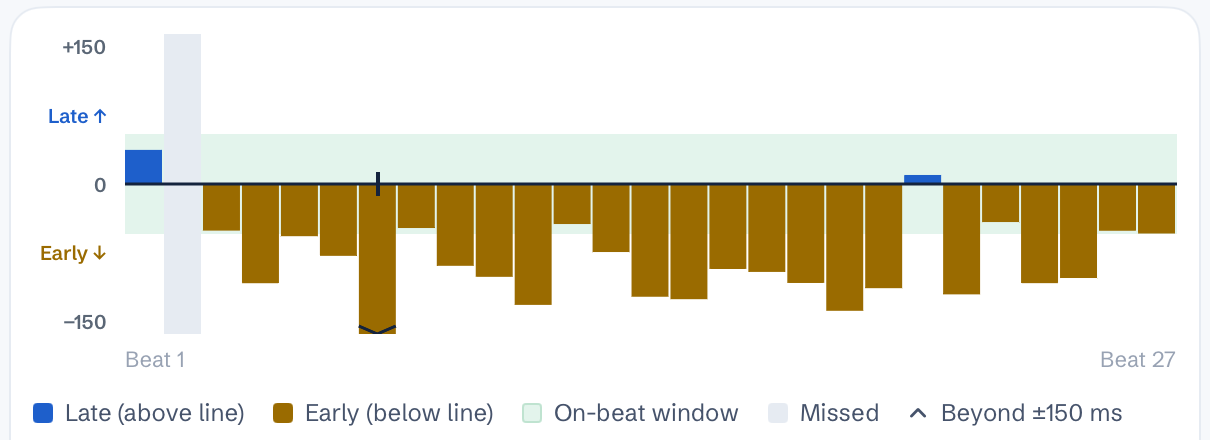
These are different outcomes. A person can average close to the beat while alternating between substantially early and late responses. Looking at the sequence of responses, alongside an average score, can reveal that pattern.
Comparisons are more informative when the response method, tempo, duration and feedback conditions remain consistent. Finger tapping and clapping also involve different movements, so they should be considered separately.
Exploring timing with Tempo Trace
Tempo Trace brings a structured rhythm task to iPhone and iPad. Users can tap the screen or clap to an auditory beat, select a tempo and session duration, and choose between training with immediate feedback and testing without live timing feedback.
The app makes the timing of a simple activity visible. Its connection to the research is the task: synchronising movement with a rhythm and reviewing the responses. The rehabilitation studies above evaluated other systems and programmes; they do not establish rehabilitation benefits for Tempo Trace.
For readers interested in rhythm, movement and learning, this offers a practical way to explore a deceptively simple question: how consistently can you meet the next beat?
Learn more about Tempo Trace →
References
-
Lehéricy S, Benali H, Van de Moortele PF, et al. Distinct basal ganglia territories are engaged in early and advanced motor sequence learning. Proceedings of the National Academy of Sciences. 2005;102(35):12566–12571. doi:10.1073/pnas.0502762102.
-
Chen JL, Penhune VB, Zatorre RJ. Listening to musical rhythms recruits motor regions of the brain. Cerebral Cortex. 2008;18(12):2844–2854. doi:10.1093/cercor/bhn042.
-
Repp BH, Keller PE. Adaptation to tempo changes in sensorimotor synchronization: effects of intention, attention, and awareness. Quarterly Journal of Experimental Psychology A. 2004;57(3):499–521. doi:10.1080/02724980343000369.
-
Karni A, Meyer G, Jezzard P, Adams MM, Turner R, Ungerleider LG. Functional MRI evidence for adult motor cortex plasticity during motor skill learning. Nature. 1995;377(6545):155–158. doi:10.1038/377155a0.
-
Thaut MH, Leins AK, Rice RR, et al. Rhythmic auditory stimulation improves gait more than NDT/Bobath training in near-ambulatory patients early poststroke: a single-blind, randomized trial. Neurorehabilitation and Neural Repair. 2007;21(5):455–459. doi:10.1177/1545968307300523.
-
Nieuwboer A, Kwakkel G, Rochester L, et al. Cueing training in the home improves gait-related mobility in Parkinson’s disease: the RESCUE trial. Journal of Neurology, Neurosurgery & Psychiatry. 2007;78(2):134–140. Full text.
-
Yu GH, Lee JS, Kim SK, Cha TH. Effects of interactive metronome training on upper extremity function, ADL and QOL in stroke patients. NeuroRehabilitation. 2017;41(1):161–168. doi:10.3233/NRE-171468.
This article is general clinical education and isn't a substitute for formal training or guidelines. Tempo Trace measures timing only; it does not diagnose, and the rehabilitation studies discussed did not evaluate Tempo Trace.